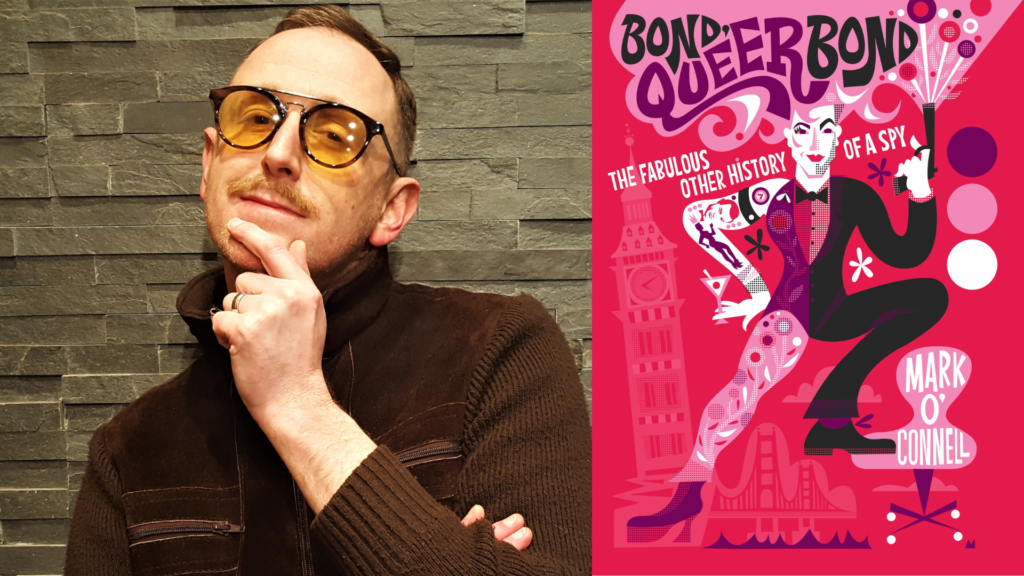
Richard meets Bond, Queer Bond author Mark O’Connell
Author Mark O’Connell is set to release his latest book Bond, Queer Bond: The Fabulous Other History of a Spy on May 14th. The book takes readers on a ride through literary and motion picture history to explore how queer culture influenced James Bond, from editors and cover artists in the ‘50s, to the drag and ballroom scene of the ‘80s. This meticulously researched book peels back the velvet curtain to reveal how a hyper-masculine character was influenced, developed and loved by queer icons.
From the vibrant Bond lyricist who created a musical genre, the hellraising artist who first branded Bond, the 1960s film editor who gave 007 his momentum, the quiet musician who became a gay icon, how pop art icons influenced Bond, the vital advocacy of a publishing editor, how the AIDS crisis saw the Bond project step up before any government did, the fashion houses that dress Bond, closeted Cold War espionage, how the world’s most influential drag and queer artists celebrated 007, why Oscar Wilde was instrumental and how author Ian Fleming was ahead of the culture-war curve.
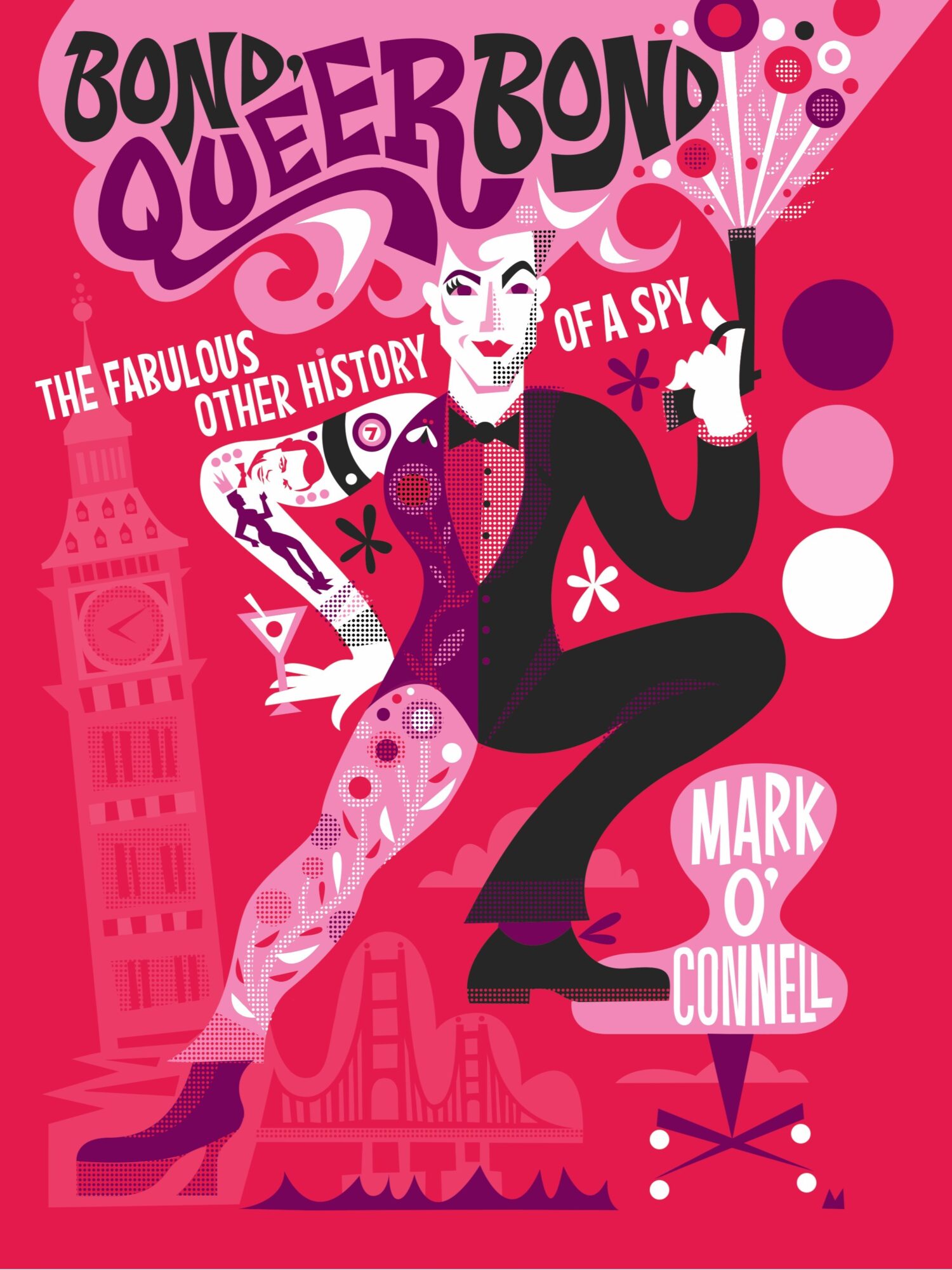
Bond, Queer Bond dives into a connective nervous system of LGBTQ+ elements that are immense and completely changes the way you look at Bond, and might even make you rethink the queer elements you’d already spotted.
I am so very delighted to introduce you to our cover star this month who took some time out of his busy schedule promoting the book to sit down and chat to me.


I am a Bond fan so I really couldn’t wait to read the book and then chat with someone that actually knows all the ins and outs of the world in a very personal way. Check out the interview below and also listen to Mark & myself on our new episode of the Bear World Podcast where we dive deeper into some of the velvety references.
Richard Jones: Mark, it is great to sit down with you. Congratulations on your third book, Bond, Queer Bond. Before we dive into the book itself, tell me about your childhood, were you exposed to movies in general, were your family in the movie business in any way?
Mark O’Connell: It was the Spring of 1983, and I was seven years old and Shredded Wheat cereals were giving away stickers from the imminent cinema release of Octopussy. Bond was already in my family before I was. My grandfather worked for thirty years for the Bond production house, Eon Productions and the Broccoli family. As a kid I would hear slithers of conversations about ‘Pierce’ and ‘Roger’ and ‘the Eiffel Tower’ and ‘Pinewood’ and ‘Cubby’. But it was a Roger Moore sticker collection hidden away in the box of wholegrain breakfast option that first got my attention.

Because of my grandfather, my dad wanted to take me to see Octopussy on its first opening weekend. But my initial Shredded Wheat interest had already faded it seemed as I quickly wanted to see Return of the Jedi again instead. I had quite the meltdown moment in the foyer of the Guildford Odeon that Divorced Parent Saturday when I was being faced with Roger Moore on a tuk-tuk, Maud Adams and Cold War armageddon, when all I wanted was Ewoks, Speeder Bikes and Luke Skywalker in his new black ensemble.
RJ: And did you love the movies straight away?
MOC: Fortunately, my dad stood his Bond ground. He refused to yield to my queeny outburst and probably revoked all candy privileges for a month as I was marched to Screen 2 to see Octopussy as planned. And thank Ian Fleming he did. I may have entered the Guildford Odeon as a young seven-year-old Star Wars kid panicked about not finishing my Return of the Jedi sticker album, but I emerged as a mature nearly-eight-year-old transfixed by all things Bond, Roger Moore, Maud Adams and Octopussy.
I was too young to appreciate all its Cold War intrigue and verbal gameplay. But I was instantly in love with the music, the opening titles, the sense of adventure and the action sequences. I was mesmerised by Rita Coolidge’s anthem and those blue and red titles.

RJ: When did you realise, or understand the queer elements of the movies?
MOC: That probably came a lot later. Like many VHS era kids, there was a moment in time where your only outlet for big Bond movies was a holiday or weekend broadcast. I remember the joy that Diamonds are Forever was coming up next Sunday night on ITV. I had not seen it and danced – minced – around the lounge on a victory lap. I then panicked a week later to first encounter the film’s homo-cidal killers Mr. Wint and Mr. Kidd. They were probably the first depiction of a gay couple I had ever seen, and my closeted little self was paranoid they would both spin around and out me to my parents in the lounge.
Yes, there would be Bond film snippets of male flesh, topless KGB beefcakes and buff henchmen in Speedos climbing out of rooftop pools. But very quickly it was that sense of Bond film presentation that beguiled me more. The Bond film project especially is a project of popular music, fashioning, design, sexuality, travel and escapism. That chimes too with a lot of queer culture, histories and audiences. And then as my own confidence as a gay youth began to blossom and find its confidence, my Bond fan fever was able to see the wider LGBTQ artistry and inputs that have elevated the 007 project in all its forms.
RJ: And what made you want to collect all those elements together into a book?
MOC: It was a combination of thoughts. With a new and very different chapter for the Bond films about to open, I wanted to do another Bond book. But I was also mentally angling to really stretch my queer literary wings and write something uniquely gay. As soon as I clicked that the queer history and queer celebration of Bond is very much uncharted waters, it made total sense to combine the two. And then as very real Bond villains across the western world are turning LGBTQ equalities, rights, cultures and books into political collateral for certain bovine minded headlines and performative bigotry, there is a delicious twist that the openly straight James Bond does actually have such a rich, vivid and consequential queer history of his own. Because surely history is not history if it does not include all histories.

RJ: What are the most important or most powerful queer elements across the Bond franchise?
MOC: There are many. Some less evident. Some blatantly so. There is a group of gay artists and creatives who each get a chapter in Bond, Queer Bond. Without them there could well have been a 007 on the written page, cinema screen, comic book, radio play and games console. But with them, the sense of elevation ensured the Bond project was a repeatable one. So, it is a gay book editor who is one of the first to recognise the book potential for Bond and his creator Ian Fleming. But, more importantly, that man recognises the scope for a returning hero and an ongoing series of adventures. It is a gay film editor and later director who changes how action cinema is edited and paced. He singlehandedly forges an editorial template for the series. And, yet the first five Bond films are released whilst it is illegal for him, and all gay men in England, to be homosexual as he is turning Sean Connery into a global emblem of heterosexual escapism.
It is a gay book illustrator who pins what the graphical language of the Bond novels could be. As he is creating the visual iconography of the Bond world and creating that sense of glamorous death, he is nicking the jacket buttons off of soldier trade and keeping them in a jar of promiscuous honour. I think we forget the sense of day-to-day risk that our LGBTQ elders had to navigate in a pre-internet, pre-legalisation world. So, it is that two-way sense of validation that both Bond and his queer artistry lend each other which is fascinating. And it feels like it is about something.
RJ: And did you discover anything surprising to even you with your Bond knowledge that blew your mind in the research?
MOC: Bond’s gay porn history is quite the thing! As gay Bond fans watch the flesh and tech of the lady-heavy Bond title sequences wishing there was once a queer minded graphical take on those overtures, it turns out the adult movie scene of the 1970s had already gone there! Quite a few titles exist out there in the under-the-counter cyber crates. One such title is Greek Lightning, an early 1970s Bond porn ‘film’ complete with its own Maurice Binder title sequence that goes there with guns and man bits as it also shamelessly uses real and somewhat unlicensed Bond soundtracks. Also, the first gay returning comic strip was a gay Bond spoof not only shedding a homage light on the Bond world but also becoming a valuable community touchstone at a time where queer publishing was precarious, for many gay folk it was a lifeline. And some underground drag scenes of the 1960s would spoof Bond but in doing so would be recording and preserving their own histories alongside enhancing 007’s.
Ultimately, perhaps the biggest and more profound discovery was how the Bond films and Bond project inadvertently stepped up to help with the early stages of the HIV/AIDS fight and messaging. It was always the late 1980s Timothy Dalton Bond movies that are held up as the series’ response to AIDS. But that had actually already happened with 1985’s A View to a Kill, Grace Jones, San Francisco and at least one night involving disco icon Sylvester. And then Bond’s own history with AIDS activism has never ended. That suddenly feels relevant and warrants a valuable spotlight in the book.
RJ: Are you stuck in watching any movie now and wondering about its queer coding, or queer connections?
MOC: Someone the other day mentioned how this new, barely talked about new TV show Heated Rivalry is a bit queer, no?!. And of course, the Bond world has been doing East meets West lovers and ice hockey rivalry decades ago! But more seriously, one of the key thrusts of Bond, Queer Bond is how it reminds that diversity is not new and visibility has always existed. We are all navigating a moment in time where our freedoms and hard-fought fights are up for debate again. But this book introduces very real and important characters that often had the balls, artistry and maybe life momentum to be able to be their real queer selves, as many did, and had to. And they were doing all this when their loves and private lives equalled prison. At best. Gay culture and queer fight did not suddenly only exist in a hashtag era. Our resilience and presence is as old as time itself. It is history that filters. But not here.
RJ: Are there any other franchises that have the same level of queer participation as Bond?
MOC: There are many existing properties, franchises and audiences favourites that owe their debt and flowers to LGBTQ artistry, decisions and pluck. And some I have my eye on. The worlds of Star Trek, Doctor Who and Marvel have gone there already with queer representation and participation. Whilst it is almost rarely a sexual universe, there is a lot of queer crossover history with Star Wars. The ill-fated 1978 Holiday Special alone was designed by Bob Mackie for starters and features queer ally Bea Arthur running what is almost a gay dive bar! But what works with Bond, Queer Bond is that openly straight framing of our man James. That is what feels so delicious right now.
As some culture war headline makers need us to panic that a gay actor might play Bond and will no doubt make him all queer and living in San Francisco (!), they would be wrong to suggest Ian Fleming himself would be turning in his grave right now. He would be quietly reminding those folk how he knew exactly what San Francisco was all about in the early 1960s as he cited its brilliant ‘wide awake’ outlook.
RJ: What’s next for you?
MOC: The world of Bond, Queer Bond is not over yet. There is plenty more fabulous other history of that spy, and I am relishing letting this one fly the nest at long last. I would also like to pursue completing my Bond book trilogy with something left-field and never-done-yet. And there are, of course, some other uniquely new takes on familiar pop culture properties I am investigating. Apart from that, I want a gay summer. I want Aperols and bad Bassey remixes in Barcelona bars. And to see Bond, Queer Bond on someone’s beach towel somewhere.
If you love Bond, if you love movies, or if you need something to remind you that our life is worth fighting for – get this book NOW!
Bond, Queer Bond is published by The History Press and is out on 14 May 2026.


